
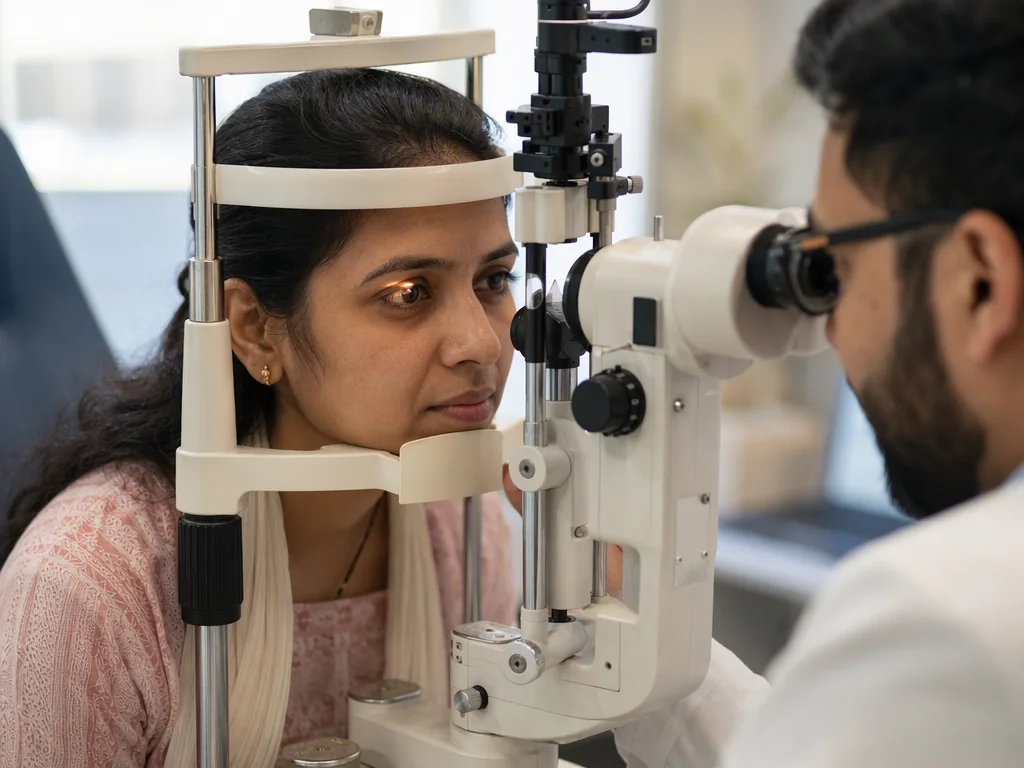
What happens during PRK
The surgeon removes the corneal epithelium and applies an excimer laser to reshape the underlying surface. A bandage contact lens is commonly used during early healing, and the epithelium grows back over time.
Because there is no LASIK flap, flap-related complications are avoided. That does not make PRK complication-free: pain, infection, haze, delayed healing and refractive uncertainty remain part of the discussion.
Why the surgeon may consider a surface procedure
Corneal thickness or shape, occupational needs, contact-sport exposure and other eye findings may influence the recommendation. Some corneas still remain unsuitable for any laser surgery.
The decision requires mapping, thickness assessment, tear-film evaluation and a comprehensive examination. A simpler online rule such as thin cornea equals PRK is not clinically reliable.
A different recovery rhythm
PRK often involves more early discomfort and slower visual recovery than LASIK. Vision may fluctuate while the surface heals. Prescribed drops, follow-up and protection from ultraviolet exposure or eye rubbing may be part of individual aftercare.
Do not drive, swim or resume contact sports until your surgeon confirms it is appropriate. The exact schedule is personal, not a universal countdown.
PRK versus other alternatives
LASIK, SMILE and ICL differ in tissue approach, eligibility and recovery. Ask the surgeon to compare these options specifically for your eyes rather than choosing from a generic ranking. Continued glasses or contacts can also be a reasonable choice.
Medical information & sources
This page provides general patient education and does not diagnose candidacy or replace an ophthalmologist’s examination. Clinical content requires final treating-doctor approval before launch.